A social media strategy should fit on one page. If it's a 40-slide deck from an agency, it will get skimmed once and then buried in a shared drive while the weekly posts get made from vibes. Here's the one-page template that actually gets used — with fill-in prompts for each section and the AI shortcuts that turn it into weekly posts.
The one-page social media strategy template
1. The goal
One number, one deadline. "Add 200 email subscribers from social by Q4." "Book 20 discovery calls a month from Instagram." "Add 50 new Google reviews from IG-driven traffic." Vague goals ("build a community") produce vague posts. Specific goals produce specific content pillars and cadence.
Fill in: By [date], we will [specific measurable outcome from social].
2. The audience
One primary customer in three lines. Who they are, what they're trying to accomplish, and which platform they already spend time on. This section is the tiebreaker for everything below — a strategy aimed at two different audiences ends up aimed at neither.
Fill in: Our primary customer is [role/segment], trying to [job-to-be-done], most easily reached on [1–2 platforms].
3. Platform pick
Pick 1–2 platforms. Not 5. Not "we should also be on TikTok because someone said we should." For most small businesses in 2026, the answer is Instagram plus one of TikTok, Facebook, or LinkedIn depending on the audience from section 2. Being everywhere and posting to nowhere is the single most common social media mistake.
Fill in: Our primary platform is [X]. Our secondary (only if capacity allows) is [Y]. We are explicitly not investing in [Z, Z, Z].
4. Content pillars
Three pillars, no more. A content pillar is a repeatable theme that every post ladders back to. Example pillars for a local coffee shop: "behind the counter" (staff, sourcing, prep), "customer moments" (photos of real customers, testimonials, reviews), and "the neighborhood" (local events, other small businesses, seasonal content). Every post you publish should fit one of the three.
Fill in: Pillar 1: [theme]. Pillar 2: [theme]. Pillar 3: [theme]. Every post fits one of these three.

5. Cadence
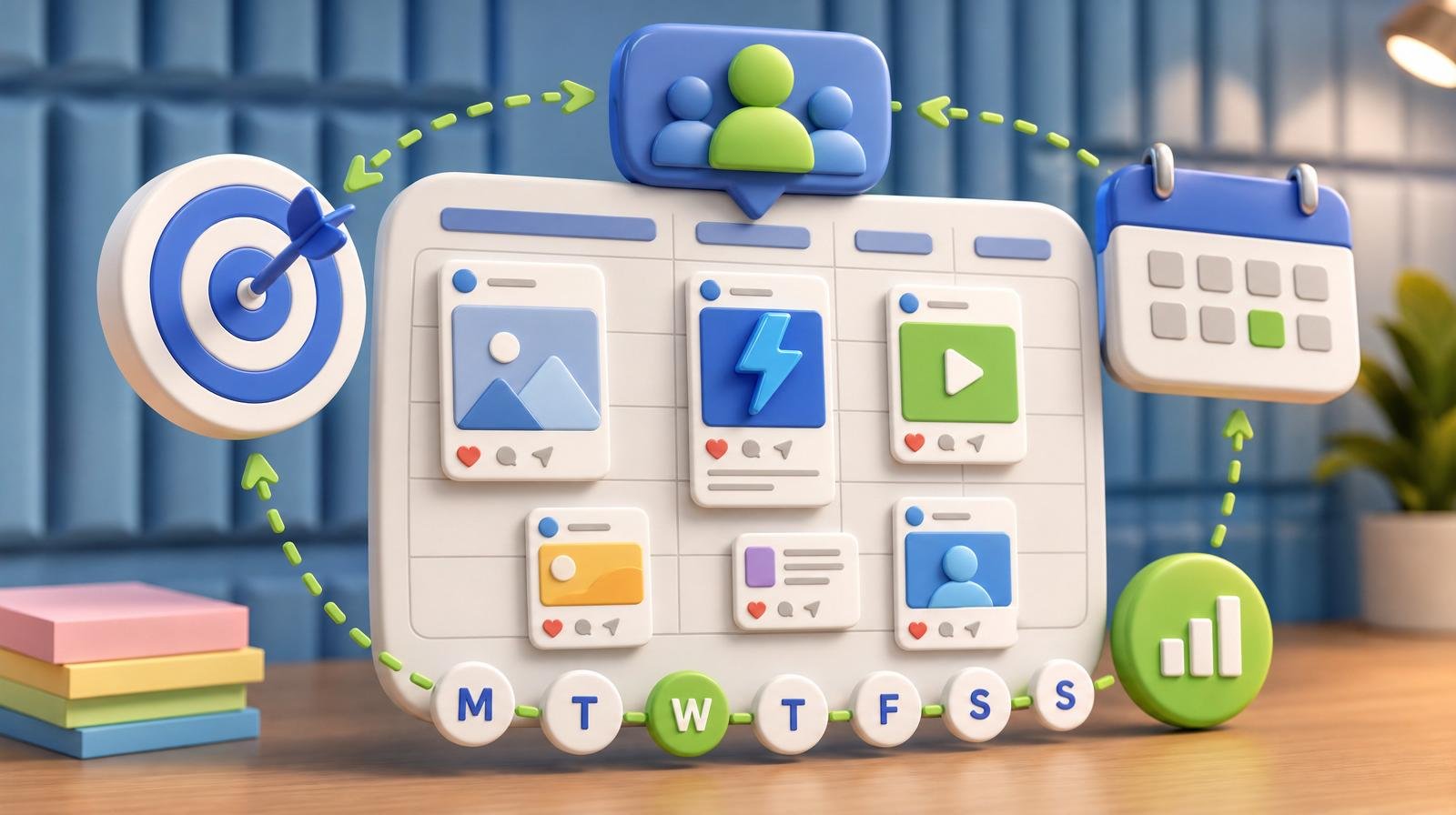
A weekly number, per platform, forever. "3 Instagram posts a week + 2 stories daily." "2 LinkedIn posts a week." "5 TikToks a week." A strategy without a cadence commitment is a wish list — and the cadence is the one commitment that quietly slips first when a business gets busy. If you can't commit to the cadence, cut the platform. Running 1 platform weekly beats running 3 platforms sporadically, every single time.
Fill in: Platform 1: [X posts per week]. Platform 2: [X posts per week]. Owned by [name/role].
This is where automation earns its keep. Social AI drafts a week of posts across your pillars in about 15 minutes and publishes them automatically, so the cadence holds even in the weeks the plan would otherwise slip. See how it works at the free trial preview. For post ideas that actually feed real pillars, see our social media post ideas guide — most work as templates you can adapt to any pillar.
6. Hooks
Three hook styles you'll use most, with 1 example each. Hooks are how the first line of every post earns the second — most social content fails inside the first 2 seconds, not because the topic is wrong but because there's no hook. Common small-business hook styles that consistently work in 2026:
- Contrarian: "Everyone tells you to post daily. Here's why we quit."
- Behind the scenes: "The 3-minute morning routine that keeps our reviews at 4.9."
- Result-first: "How we booked 20 clients last month from one Instagram story."
Pick 3 that fit your voice. Use them as the opening line of every post until they stop working, then swap in new ones.
7. Measurement
Three metrics, checked weekly. The three that map to revenue in 2026 are reach (how many new eyeballs), saves (how much the content is worth revisiting), and DMs or link clicks (how much intent it's creating). Follower counts are vanity — don't put them on the page.
Fill in: The 3 metrics we check every Monday are: [reach], [saves], [DMs or link clicks].
How this template compares to what most businesses actually use
| Approach | Length | Time to build | Actually referenced |
|---|---|---|---|
| One-page social strategy (this template) | 1 page | 60–90 minutes | Weekly, as a checklist |
| Agency strategy deck | 30–60 slides | 4–8 weeks + $$$ | Once, at handover |
| Random ideas in a Notes app | N/A | 0 minutes | N/A — no through-line |
| Copying a competitor | 0 pages | 0 minutes | No — voice mismatches you |
Comparing the one-page social media strategy template against the alternatives most small businesses default to in 2026.
The AI shortcuts that turn the strategy into weekly posts
The strategy is worthless if the posts don't ship. Three AI shortcuts do more of the weekly execution work than anything else:
- Content generation. Feed the strategy (audience, pillars, voice, hook styles) into an AI tool once, and use it to draft every post from that day forward. Our Social AI for small business guide covers the full workflow.
- Scheduling and publishing. Never open the platform apps to post manually. Social AI queues a week of posts in one sitting and publishes them across Instagram, Facebook, TikTok, LinkedIn, and more automatically.
- Brand consistency. Feed your one-page brand guidelines into Brand Intelligence once, and every AI-generated post inherits your voice, tone, and colors — so the cadence never comes at the cost of the brand.
What to do this week
- Copy the 7 fill-in prompts above into a blank document.
- Answer each one in 1–2 sentences. Don't overthink it — first draft in 60–90 minutes.
- Pick 1–2 platforms and commit to a weekly cadence you can actually hold for 12 months.
- Every Monday, glance at the 3 metrics in section 7. If a metric drops two weeks in a row, that's the pillar or hook style you fix.
- Once a quarter, redo the whole page from scratch. Same 7 questions, fresh answers.
Putting it all together
A great social media strategy is not a great slide deck — it's a great weekly rhythm held to by a single sheet of paper that answers seven questions. Fill in the template, pick 1–2 platforms, commit to a weekly cadence, and let AI handle the drafting and publishing work that would otherwise slip. If you'd like the whole stack — strategy, content, publishing, reviews, listings — running from one dashboard, check ClickGrow pricing or create a free account to get started.